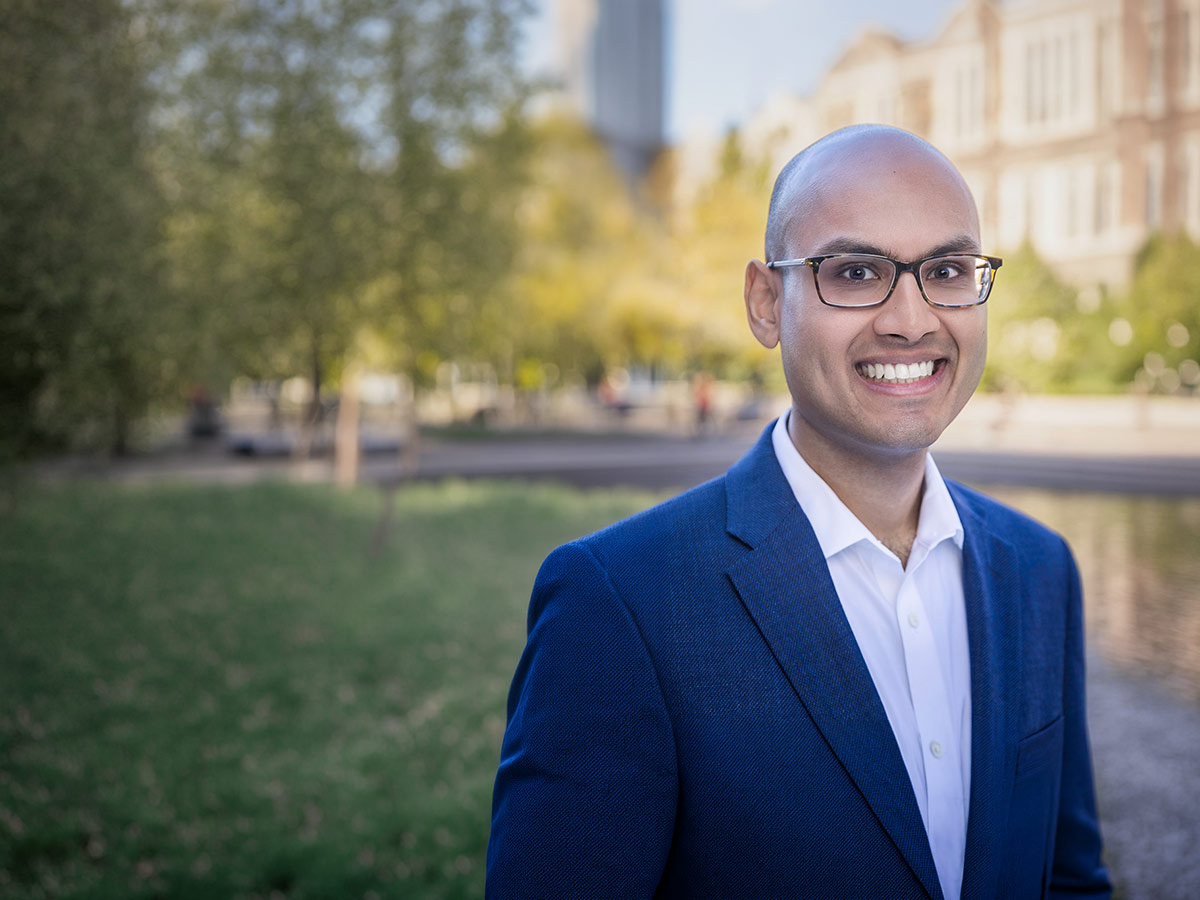
The Infosys Prize 2026 for Economics is awarded to Karthik Sastry, Associate Professor at Princeton University, for his pioneering contributions to the field of climate change, and technological innovation, and to the study of business cycle fluctuations. His work gives deep insights into how societies adapt to climate change through technological innovation and is likely to have far-reaching policy implications.
Scope and Impact of Work
Prof. Karthik Sastry is a macroeconomist with broad research interests. He asks relevant and fundamental questions, and his work on business cycles incorporates several realistic behavioral and market realisms, such as bounded rationality, information diffusion and non-market clearing scenarios. These have potentially significant consequences, in terms of methodology as well as policy design. His work on contract design adds another dimension to the notion of incomplete contract, with applications in various related areas such as law and economics, regulation and procurement.
Prof. Karthik Sastry’s work on climate and technological innovation shows how societies adapt to climate change through policies and technology shifts. Technology not only affects productivity, but also affects producers’ ability to cope with climate shocks. In agriculture this can take place through different crop varieties, fertilizer use, cropping pattern and other means of diversification. Sastry’s work can serve as the foundation for extensions and applications, asking similar questions in different contexts. While some forms of technological innovation seem to be the result of adaptation to climate change, public research and policy can also play a significant role.
As is widely believed, technology has a big role in development. It provides solutions to some of the challenges, but it also brings new challenges. How society adapts to these will be a key question. Research on this issue can draw methodological inputs from Karthik’s work.
Karthik Sastry has already made a huge impact, which will grow manifold, given his research agenda and pipeline of projects.
Bio
Karthik A. Sastry is an Associate Professor of Economics and Public Affairs at Princeton University. He received his A.B. in Economics from Princeton in 2016, and Ph.D. in Economics from the Massachusetts Institute of Technology in 2022. He was a Prize Fellow in Economics, History and Politics at Harvard University for a year before joining Princeton University in 2023. He is the recipient of several awards and grants, most recently, the prestigious John Witherspoon Bicentennial Preceptorship (2026-29) at Princeton.
Prof. Sastry has contributed to several areas, showing his depth as well as breadth. His work has been published in leading journals such as the American Economic Review, Econometrica, Journal of Political Economy, Journal of Economic Theory, NBER Macroeconomics Annual and the Quarterly Journal of Economics. He is also a Faculty Research Fellow of the National Bureau of Economic Research.
Timeline
Jury Citation
Prof. Karthik Sastry has one of the most diversified portfolios of research, with contributions to economic theory, macroeconomics, technology, and environmental economics. He uses both theoretical modelling and empirical analysis to answer a rich and interesting set of questions. A key feature of Prof. Sastry’s research is to examine how societies adapt to climate change (and rising temperature) through innovation and public policies. Exposure to heat extremes has led to a substantial increase in crop varieties in agriculture. Likewise, agricultural policies designed to mitigate climate shocks can have mixed implications, when multiple countries face similar shocks. The second focus of Sastry’s research is the study of fluctuations in economic activity in the absence of unbounded rationality and full market clearance. Karthik Sastry has also made seminal contributions to the study of contract design when information is incomplete and evidence is costly.
Karthik A. Sastry
My congratulations to Karthik Sastry, the winner of the 2026 Infosys Prize for Economics, for his outstanding contributions to the study of climate change, resilience, the economics of innovation, and macroeconomic fluctuations. The novelty and breadth of his contributions are quite amazing. My fellow jury members, Levon Barseghyan, Roberta Gatti, Ajit Mishra, Sudipta Sarangi and Tavneet Suri, and I were taken in by the range and originality of his research, all done at this young age. His research raises interesting, socially-relevant questions, and is likely to have important implications for policymaking. Congratulations, Karthik.